
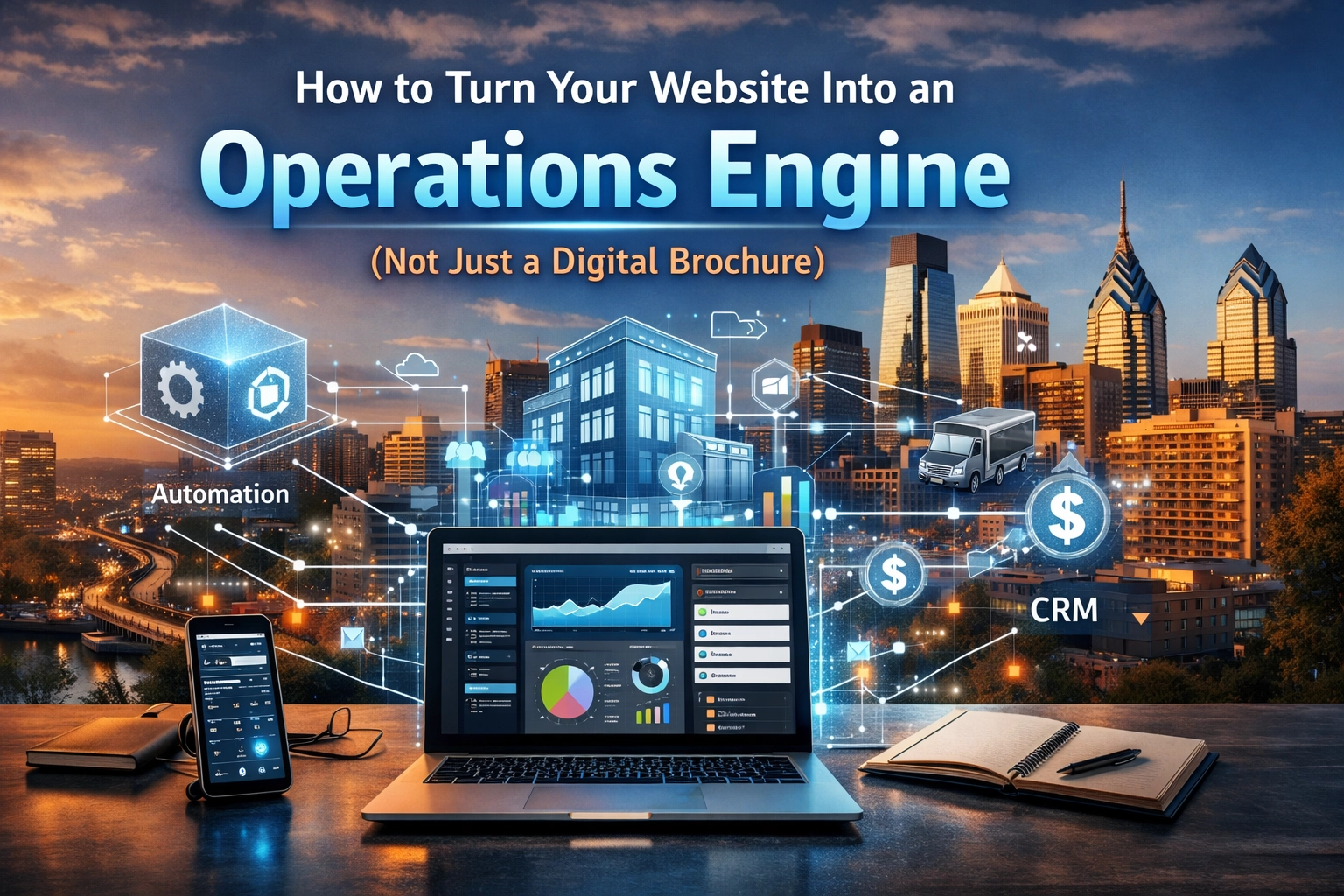
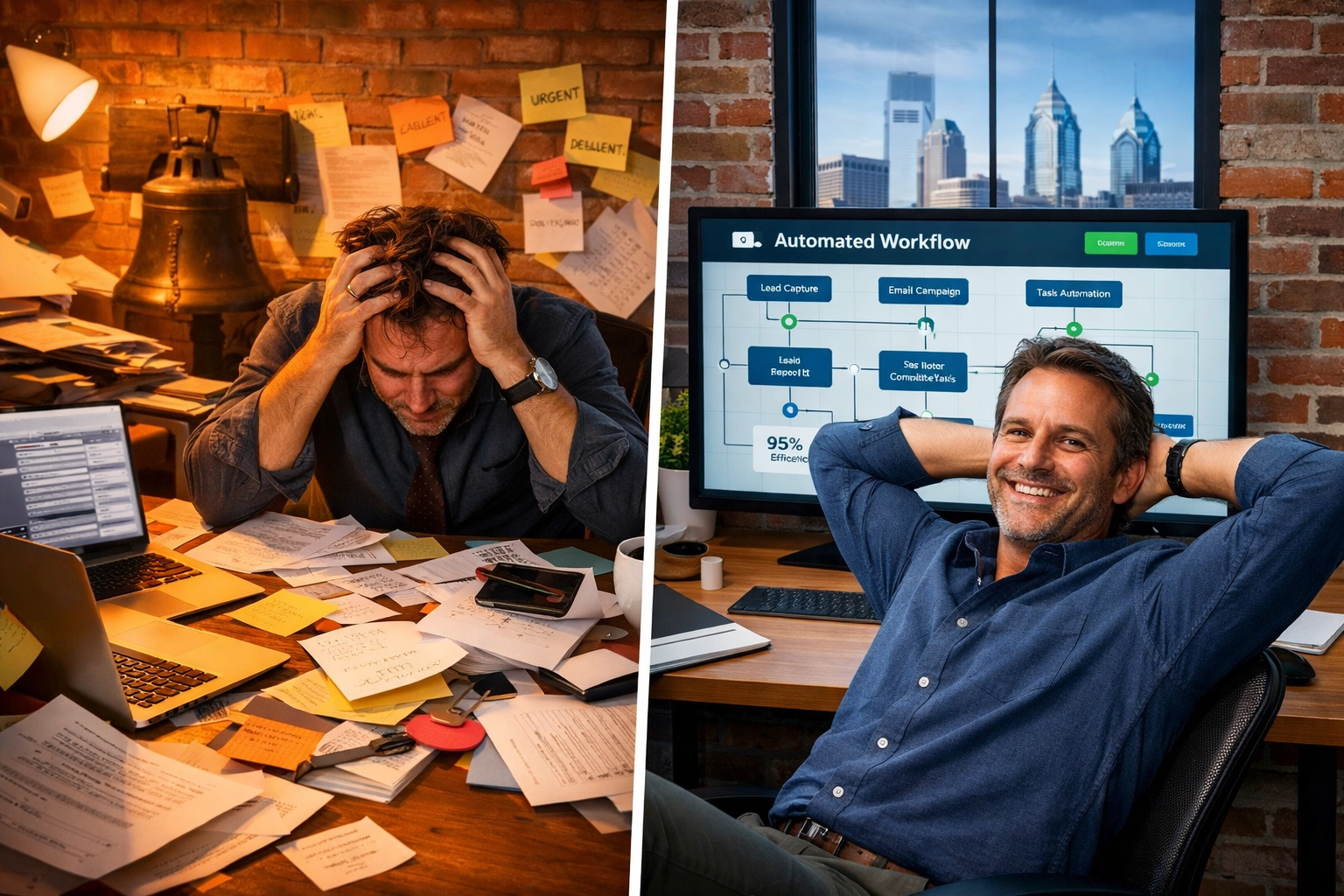
Most business websites are glorified digital brochures. They look nice, show your services, maybe have a contact form: and that's about it. Your team still does everything manually: fielding calls, sending follow-up emails, updating spreadsheets, chasing down leads who never responded.
Here's the truth: your website can do so much more than sit there looking pretty. It can be the central nervous system of your business: capturing leads, routing inquiries, syncing with your CRM, triggering follow-ups, and feeding your team the exact information they need, exactly when they need it.
For Philadelphia small businesses competing in 2026, that's not a luxury. It's table stakes.
The Brochure Website Problem
A brochure website displays information. That's it. Visitors read about what you do, maybe admire your portfolio, and then… what? They have to pick up the phone, send an email, or fill out a basic form that drops into someone's inbox where it sits until someone notices it.
Meanwhile, you have no idea:
- Where that lead came from
- What pages they visited
- Whether they're ready to buy or just browsing
- If anyone followed up
- Whether they booked a call or ghosted
That's not a website. That's a missed opportunity factory.
What an Operations Engine Actually Does
An operations engine website doesn't just inform: it functions. It collects data, triggers actions, updates systems, and keeps your business moving without constant human intervention.
Here's what that looks like in practice:
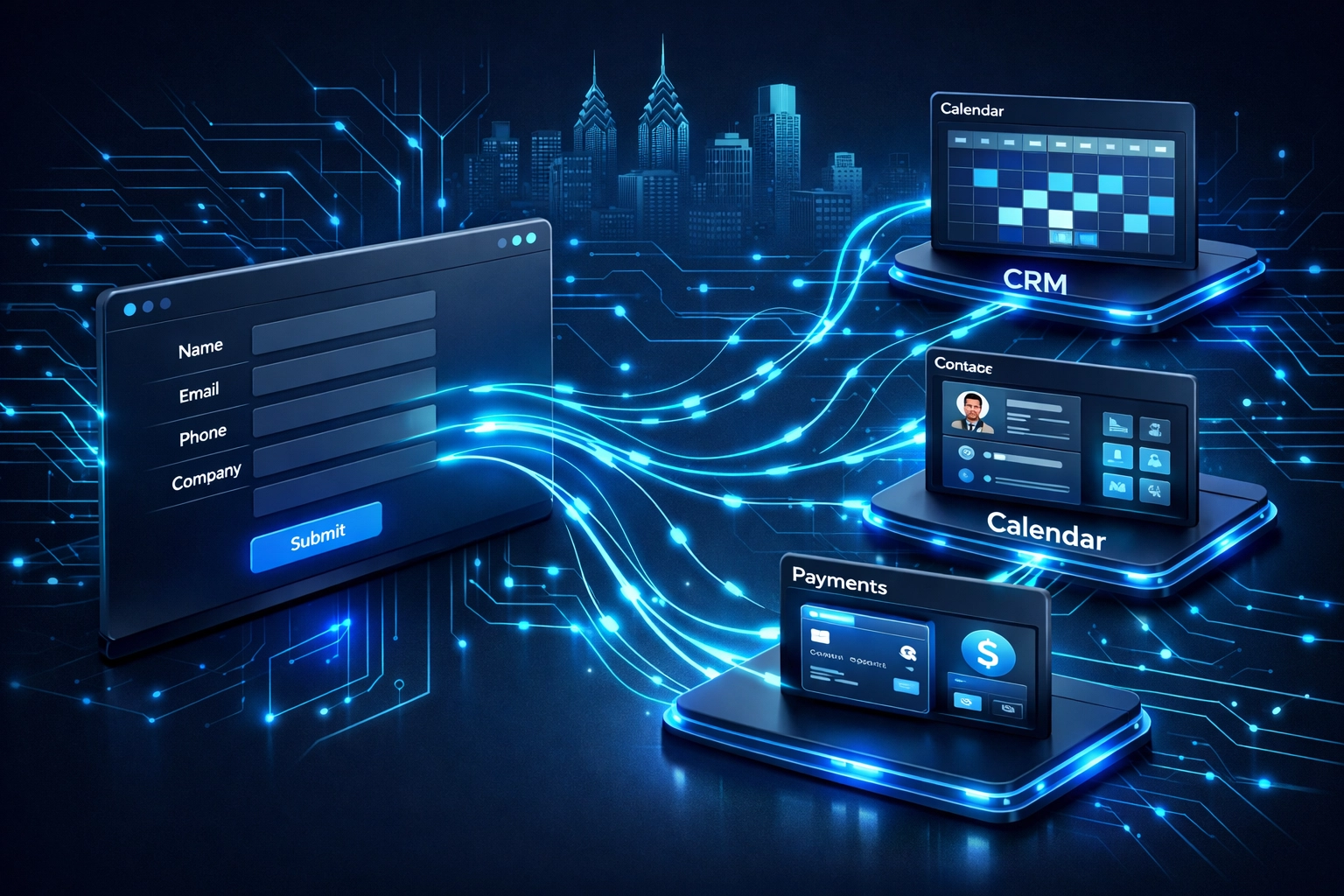
Lead capture that works: Forms don't just collect names and emails. They route inquiries based on service type, urgency, or location. High-value leads get flagged immediately. Everything logs directly into your CRM with tags, timestamps, and source tracking.
Automated follow-up sequences: Someone fills out a form at 11 PM? They get an immediate confirmation email, a calendar link for booking, and a follow-up two days later if they haven't scheduled. No one on your team had to think about it.
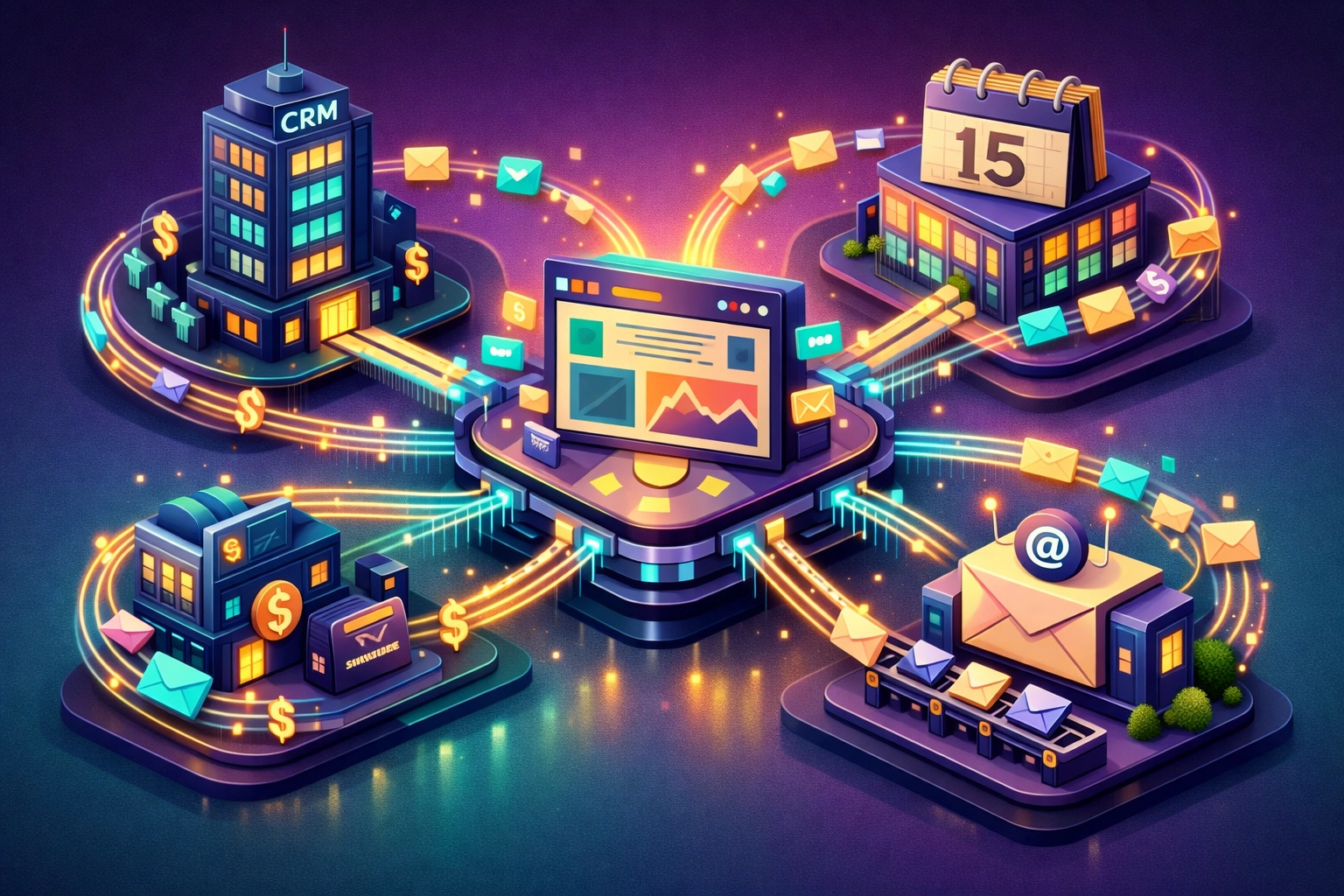
Real-time data syncing: When a lead converts to a client, your CRM updates, your project management tool creates a new project, and your accounting system generates an invoice. No duplicate data entry. No falling through the cracks.
Self-service functionality: Clients can check project status, upload documents, reschedule appointments, or pay invoices: all through your website. Your team stops playing email tag and starts focusing on higher-value work.
The Core Features That Make It Happen
Building an operations engine doesn't mean ripping out your current site and starting from scratch. It means layering in the right functionality, step by step.
Smart Forms with Conditional Logic
Basic contact forms are dead weight. Modern forms should adapt based on how people answer. If someone selects "Urgent Project," they see different fields than someone selecting "General Inquiry." If they choose a specific service, the form routes to the right department automatically.
This isn't fancy: it's just smart website development that respects both your time and your customer's time.
CRM Integration (Not Just "Send to Email")
Every form submission, chat interaction, and phone call should flow directly into your CRM with proper field mapping. That means:
- Contact info goes to the right fields
- Service interest gets tagged appropriately
- Source tracking shows which marketing actually works
- Lead scores update automatically based on behavior
When your website talks directly to your CRM, you stop losing leads in inbox chaos.
Booking and Scheduling Systems
If your business requires consultations, estimates, or service appointments, your website should handle scheduling. Tools like Calendly or Acuity integrate seamlessly with modern websites, letting prospects book time slots without the back-and-forth email dance.
Even better: automated reminders reduce no-shows, and calendar syncing means your team always knows what's coming.
Payment and Invoice Automation
For service businesses, getting paid shouldn't require manual invoice creation and follow-up emails. Your website can:
- Generate invoices automatically when projects close
- Send payment links directly to clients
- Trigger reminder sequences for overdue invoices
- Sync payment status with your accounting software
This is especially powerful for Philadelphia businesses serving local clients who expect convenient, modern payment options.
Where AI Makes the Difference
AI isn't about replacing your team. It's about handling the repetitive stuff so your team can focus on relationship-building and complex problem-solving.
Intelligent chat widgets can answer common questions 24/7, qualify leads, and route serious inquiries to the right person. Unlike old-school chatbots that frustrated everyone, 2026 AI chat actually understands context and provides genuinely helpful responses.
Lead scoring uses AI to analyze behavior patterns: time on site, pages visited, form interactions: and predict which leads are most likely to convert. Your sales team stops wasting time on tire-kickers and focuses on serious prospects.
Content personalization shows different messaging to first-time visitors versus returning leads versus existing clients. Someone researching "Philadelphia web design" sees different content than someone who visited your pricing page three times last week.
Want to explore how AI can streamline your operations? Check out our content marketing services to see how we help businesses create and distribute smarter content.
Making This Work for Local Service Businesses
Philadelphia small businesses have a specific advantage here: you're not trying to serve everyone everywhere. You're serving a local market with specific needs.
That means your operations engine can be hyper-targeted:
- Forms can pre-filter by service area
- Pricing can adjust based on Philadelphia zip codes
- Local SEO integration ensures you're capturing the right search traffic
- Follow-ups can reference local landmarks, events, or business conditions
Your website becomes the hub that connects your local presence with operational efficiency.
Getting Started: The Priority List
You can't (and shouldn't) implement everything at once. Here's the right sequence:
Phase 1: Foundation
- Implement proper form-to-CRM integration
- Set up basic automated confirmations and follow-ups
- Ensure your hosting infrastructure can handle integrations reliably
Phase 2: Enhancement
- Add scheduling/booking functionality
- Build out lead scoring and routing logic
- Implement payment and invoice automation
Phase 3: Optimization
- Layer in AI chat and support tools
- Personalize content based on visitor behavior
- Create self-service client portals
Each phase builds on the last. Trying to jump straight to Phase 3 without Phase 1 working perfectly is a recipe for chaos.
The ROI You Actually Care About
Let's be specific about what changes when you move from brochure to operations engine:
Time savings: Your team stops doing manual data entry, sending individual follow-ups, and tracking leads in spreadsheets. We're talking hours per day, depending on your lead volume.
Fewer dropped leads: When follow-up is automatic and nothing sits in someone's inbox, you stop losing deals to slow response times or forgotten follow-ups.
Better client experience: Clients get immediate responses, can self-serve for simple tasks, and don't have to repeat information across multiple interactions.
Scalability: When systems handle the routine stuff, your team can handle more volume without hiring more people.
What to Avoid
The biggest mistake businesses make is over-complicating things. You don't need 15 different tools all talking to each other through duct-tape integrations. You need a few solid tools, properly configured, with clear data flows.
Don't chase "all-in-one" platforms that promise to do everything. They usually do everything poorly. Focus on best-in-class tools that integrate cleanly. Need help figuring out the right stack for your business? Let's talk.
Your Website, Reimagined
A digital brochure costs money every month and generates leads at random. An operations engine works for you 24/7, qualifying prospects, automating follow-ups, and keeping your business running smoothly even when you're not actively managing it.
For Philadelphia small businesses, that's not about being cutting-edge or tech-obsessed. It's about competing effectively in 2026, when your competitors are already using these tools and your customers expect this level of responsiveness.
The question isn't whether to upgrade: it's how fast you can implement the changes that matter most.
Your website should be your hardest-working employee. Time to make it earn its keep.
The 2026 Website Stack: What Philadelphia Businesses Should Use (and What to Avoid)
Let's talk about your website stack: the collection of tools, platforms, and tech that powers your online presence. If you're a Philly business owner trying to figure out what to use in 2026, you're probably drowning in options. WordPress or custom? Wix or Webflow? Should you even care about the backend stuff? Here's the truth: your stack matters, but not in the way most tech blogs tell you. It's not about using the "coolest" tools. It's about picking what actually works for your business, your team, and your customers: without creating a maintenance nightmare six months down the road. Let's break down what Philadelphia businesses should lean into this year, and what you're better off avoiding. The Core Foundation: CMS Platforms That Make Sense Your Content Management System is the engine of your website. It's where you update content, add pages, and manage the day-to-day stuff. In 2026, the right CMS depends entirely on what you're trying to do. WordPress is still the workhorse for most businesses, and for good reason. It's flexible, SEO-friendly, and has a massive ecosystem of plugins and developers. If you need a blog, service pages, and some basic automation, WordPress paired with a solid...
How to Turn Your Website Into an Operations Engine (Not Just a Digital Brochure)
Most business websites are glorified pamphlets. They tell people what you do, maybe show some nice photos, and then… that's it. Visitors leave. Maybe they bookmark you. Probably they don't. But what if your website could actually run parts of your business? What if it could qualify leads, schedule appointments, collect payments, update your CRM, and send follow-ups, all without you lifting a finger? That's the difference between a digital brochure and an operations engine. And in 2026, if you're still treating your website like the former, you're leaving serious money on the table. The Digital Brochure Problem Here's what a typical small business website does: Displays your services Shows your contact info Maybe has a basic contact form Sits there looking pretty And here's what it doesn't do: Capture structured data you can actually use Connect to your existing tools Automate repetitive tasks Help you close deals faster Reduce the manual work your team does daily If someone fills out your contact form right now, what happens? Does it land in a spreadsheet? Get forwarded to three different people? Sit in an inbox until someone remembers to follow up? That's not a system. That's chaos with a nice-looking...
Your 2026 Upgrade Plan: 30 Days to a Smarter Website + Smarter Operations for Philadelphia Businesses
Let's be honest: most Philadelphia business owners know their website could be better. You've been meaning to update it. You know automation would save you time. You've heard about AI tools but haven't pulled the trigger. Here's the thing: you don't need six months and a massive budget to make real progress. You need a focused 30-day plan that tackles the stuff that actually moves the needle. This isn't about perfection. It's about building a website and operational system that works harder than you do. Let's break it down week by week. Week 1: Audit What You Have (And What's Holding You Back) Before you build anything new, you need to know what's broken. Days 1-3: Performance Check Run your site through PageSpeed Insights and check mobile responsiveness on actual devices: iPhones, tablets, whatever your customers use. Philadelphia residents search on mobile constantly, especially for local services. If your site loads slowly or looks weird on a phone, you're losing people before they even read your first sentence. Document what's slow. Note what breaks. Take screenshots of anything that looks off. Days 4-5: Content & SEO Inventory Walk through every page on your site. Is the messaging clear? Do...
The 2026 Website Stack: What to Use and What to Avoid (A Philadelphia Business Owner's Guide)
Let's talk about something that confuses the hell out of most business owners: your website tech stack. If you've ever sat through a meeting where a developer rattled off frameworks, databases, and acronyms you've never heard of, only to leave more confused than when you walked in, this one's for you. Here's the truth: most Philadelphia businesses don't need a complicated tech stack. What you need is a smart one that actually supports your business goals without requiring a computer science degree to maintain. Let's break down what's worth using in 2026, what you should avoid, and how to make decisions that won't haunt you a year from now. The Stack Isn't About Being Fancy, It's About Function Your website stack is basically the combination of tools, platforms, and technologies that make your site work. Think of it like building a house: you need a solid foundation, good framing, reliable systems, and finishes that don't fall apart after six months. But here's where businesses go wrong: they either over-build (using enterprise-level tools for a five-page site) or under-build (choosing the cheapest option and wondering why nothing works together). The goal isn't to have the most impressive tech. It's to...
How to Turn Your Website Into an Operations Engine: The 2026 Integration Blueprint
Your website shouldn't just sit there looking pretty. In 2026, it needs to work, and work hard. Too many Philadelphia businesses treat their website like a digital brochure. It shows what you do, maybe collects a few emails, and that's about it. But here's the thing: your competitors are already turning their websites into full-blown operations engines. They're capturing leads, syncing data, triggering workflows, and closing deals while you're still manually copying form submissions into spreadsheets. Let's fix that. What Does an "Operations Engine" Actually Mean? Think of your website as the central hub where everything connects. When someone fills out a contact form, that data doesn't just sit in your inbox, it flows into your CRM, triggers a follow-up sequence, updates your sales dashboard, and maybe even schedules a discovery call automatically. When a customer books a service, your calendar updates, your invoicing system generates a bill, your team gets notified, and the client receives a confirmation, all without you lifting a finger. That's an operations engine. It's not about adding more tools. It's about making the tools you already use talk to each other so your website becomes the nerve center of your business. Why Philadelphia Businesses...
What Visitors Actually Expect From Your Website in 2026 (And How to Deliver It)
Your website isn't competing with other businesses in your industry anymore. It's competing with Amazon, Netflix, and every other slick digital experience your visitors use daily. And here's the thing: they're not being unreasonable about it. They've just been trained to expect certain things, and if your site doesn't deliver, they're gone before you can say "bounce rate." Let's talk about what visitors actually expect in 2026: and more importantly, how Philadelphia businesses can deliver without breaking the bank or hiring a team of developers. Speed Isn't Negotiable Anymore Your website has about 2-3 seconds to load before visitors mentally check out. Not 5 seconds. Not "it loads eventually." Two to three seconds, tops. Why? Because speed communicates professionalism. A slow site tells visitors you either don't care about their time or you don't know what you're doing. Neither message is great for business. The good news? Modern website development practices can get you there without requiring a computer science degree. We're talking optimized images, clean code, proper hosting infrastructure, and strategic use of caching. These aren't fancy extras: they're the foundation. Mobile users are especially unforgiving. Over 70% of your traffic is probably coming from phones, and mobile...
Stop Treating Your Website Like a Brochure: Turn It Into an Operations Engine
Let's be honest: most small business websites are glorified digital pamphlets. They tell visitors what you do, where you're located, and maybe showcase a few photos. Then they just… sit there. Waiting. Hoping someone fills out a contact form or picks up the phone. But here's the thing, your website can do so much more than that. In 2026, the gap between businesses that treat their websites like brochures and businesses that use them as operational engines is massive. And it shows up where it counts: in your lead quality, your team's efficiency, and your bottom line. If you're a Philadelphia-based business owner still thinking of your website as "something you have to have," this post is your wake-up call. Let's talk about what it means to turn your site into a working part of your business, not just a digital billboard. What Does an "Operations Engine" Actually Mean? An operations engine doesn't just inform visitors, it does things. It collects data, triggers actions, feeds your CRM, books appointments, follows up with leads, and adapts based on who's visiting and what they need. Think of it like this: a brochure website is a vending machine. It displays options, and...
How to Turn Your Website Into an Operations Engine: The 2026 Integration Blueprint
Your website shouldn't just sit there looking pretty. In 2026, the businesses winning in Philadelphia: and everywhere else: are the ones treating their websites like operational hubs that actually do things. We're talking about automating workflows, syncing data in real time, and connecting every tool in your stack so nothing falls through the cracks. If your website is still just a digital brochure, you're leaving money on the table. Let's fix that. What Does "Operations Engine" Actually Mean? Think of your website as the control center for your business. When someone fills out a form, that lead doesn't just sit in an inbox: it flows directly into your CRM, triggers a follow-up email, updates your sales pipeline, and maybe even schedules a meeting. When a payment comes through, it syncs with your accounting software and kicks off your fulfillment process. That's an operations engine. Your website becomes the launchpad for automated workflows that save time, reduce errors, and keep your team focused on actual work instead of data entry. Most Philadelphia small businesses we talk to are running 5-10 different tools: a CRM, an email platform, a scheduler, accounting software, maybe a project management system. The problem? None of...
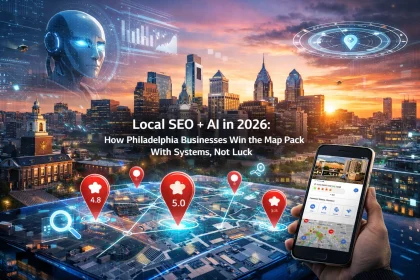
Local SEO + AI in 2026: How Philadelphia Businesses Win the Map Pack With Systems, Not Luck
Let's be honest: when someone in Fishtown searches "plumber near me" at 11 PM with a leaking pipe, they're not scrolling past the map pack. They're calling one of those three businesses at the top. If you're not there, you don't exist. The gap between businesses that consistently show up in Philadelphia's local map pack and those that don't isn't about luck, budget, or how long you've been around. It's about systems. And in 2026, those systems run on AI. Here's what actually works: and what Philadelphia businesses need to stop guessing about. Why Most Philly Businesses Are Invisible in Local Search Walk down any commercial corridor in Philadelphia: Passyunk, Germantown Ave, East Girard: and you'll find dozens of great businesses that barely register in local search results. Not because they're bad at what they do, but because they treat local SEO like a one-time task instead of an operating system. They set up a Google My Business profile three years ago. Maybe they asked for a few reviews. Then they moved on, hoping Google would "figure it out." Google didn't figure it out. Google rewards consistency, signals, and fresh data: things that only happen when you build repeatable...