
Category: AI Integrations
A small delivery operation’s morning can begin with a stack of orders, a map, and a practical question: which stop goes where, in what order, and with what on each truck? Used thoughtfully, ai for logistics can organize the day’s delivery work: draft routes from actual orders, assemble driver manifests, gather proof of delivery, and flag issues for review. The owner or dispatcher still confirms the plan and handles customer communication.
The delivery day, from orders to records
For a small courier, bakery, florist, grocery, or furniture delivery team, the day’s information might be scattered across order emails, a spreadsheet, sticky notes, a whiteboard, and group texts with drivers. That can make it hard for the office to know what each vehicle is carrying or which stops are complete.
The bigger challenge is the gap between what was planned in the morning and what actually happened by 3 PM. A late stop, an access problem, or a delivery note sent by text can be easy to miss when the details are spread across different places. AI can help gather and organize those details, provided people can check the original information and correct the draft.
What AI can prepare, with a person reviewing
A useful system should make the work easier to verify, not just produce a polished-looking summary.
- Morning route plans: Draft a route from the actual order list, with stop order and timing visible. A dispatcher or owner reviews the proposed plan and adjusts or confirms every stop.
- Driver manifests and stop sheets: Assemble a sheet for each vehicle with the items, addresses, and special instructions. The person responsible checks it before printing or sending it to a driver.
- Stop-status summaries: Gather driver updates into a clear progress view so the office can see reported activity without calling for every update. Keep the original driver notes available.
- Proof-of-delivery records: Organize photos, signatures, and delivery notes and match them to the relevant order. A person checks the match and files the record.
- Failed-delivery summaries: Pull together what happened, which order was affected, and a possible next step. The summary helps a person decide what to do, rather than taking action on its own.
- End-of-day recaps: Draft a report of completed stops, exceptions, and undelivered items that may need to be carried into tomorrow’s planning.
The review screen matters. It should show the original order beside the drafted stop or manifest line. That lets someone check the source details, rather than relying on a confident-sounding summary.

What AI should never do alone
Delivery details affect real customers and valuable goods, so some decisions need a person’s approval. AI should not change a route or stop order without confirmation, promise a customer a delivery time that the day’s actual progress does not support, or mark an order delivered without verified proof.
It should also never discard or overwrite original delivery documents, including photos, signatures, and signed tickets. Nor should it decide which failed delivery gets handled first or contact customers about failed deliveries without a person approving the action. If a detail cannot be verified, keep it marked as uncertain and show what information is missing.
A four-week adoption path
A measured start makes it easier to see whether the system is genuinely helping:
- Week 1: Draft one morning route plan from the order list. The owner adjusts and confirms every stop.
- Week 2: Add driver manifests and stop sheets for each vehicle. Compare the plan with what happened during the day.
- Week 3: Add proof-of-delivery organization and failed-delivery summaries. Review every entry against the original order and its evidence.
- Week 4: Add an end-of-day recap. Review accuracy and time saved, then decide which steps are ready to become routine.
Keep the original delivery documents throughout the pilot. They provide a way to check the system’s work and maintain a reliable record if questions come up later.

This is a hypothetical illustration, not a real client or result.
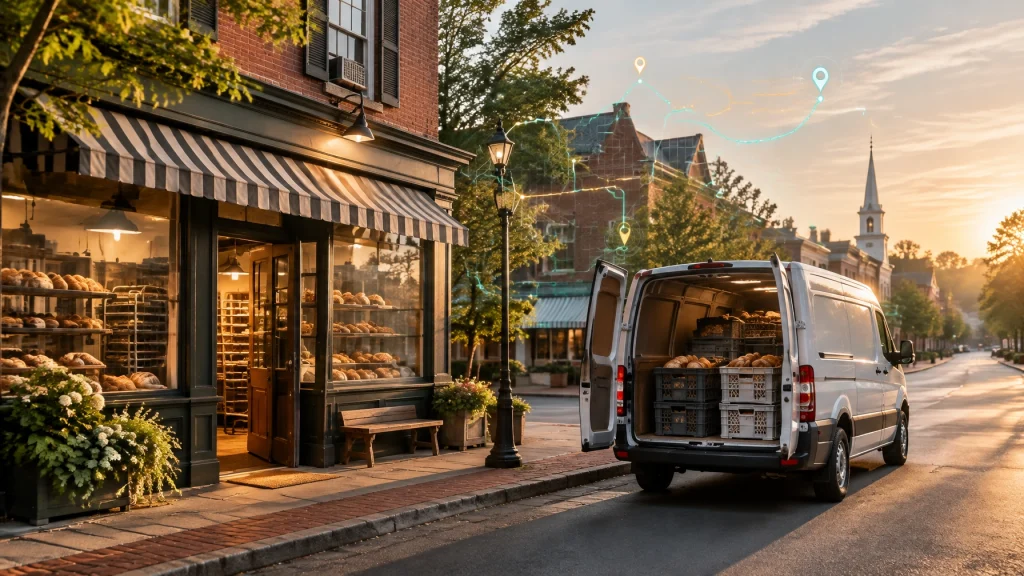
A hypothetical bakery in Doylestown could use this approach for same-day local delivery. In the morning, a person checks a draft route and confirms which orders go on each vehicle. Drivers receive reviewed stop sheets, and delivery photos or signatures are gathered against the correct orders. If a stop cannot be completed, AI could prepare a short summary for the owner to review. The owner, not the software, approves the next step and any customer message.
Your website is part of the delivery operation
Delivery-day organization starts with clear information at order time. An order or request page can capture the address, items, delivery instructions, and any details a driver will need. Delivery-area and cutoff-time pages help customers understand where and when the business delivers. Clear instructions at checkout or during order intake can reduce avoidable confusion later.
A well-structured website can also make the information easier to pass into the tools your team uses. Custom Web Design Services can help create an order experience suited to your business. AI Automation Systems can help connect repetitive information-handling tasks, while Local SEO Services can help nearby customers find your delivery business online.
This delivery-day focus is different from AI organizing goods being bought and moved upstream, as covered in our post on AI for supply chain operations. It is also distinct from AI for inventory management and AI for customer service. Here, the focus is the delivery work itself: preparing the day, keeping records organized, and making exceptions easier for a person to review.
The best starting point is a small, checkable workflow, with original orders and delivery documents kept within reach. If you’re exploring ways to make your website and delivery processes work better together, contact BENT Enterprise to talk through your goals.