Let’s be honest: the "website stack" conversation has become a total headache. If you’re a small business owner in Philadelphia: whether you’re running a law firm in Center City or a boutique HVAC company in Fishtown: you’ve likely been bombarded with buzzwords. Headless CMS, AI-native architectures, edge computing, serverless functions…
It’s enough to make you want to stick with a yellow-page ad and a prayer.
But here in 2026, the stakes have changed. A website isn't just a digital brochure anymore; it’s the operating system for your business. If your stack is disconnected, your business is leaking revenue. If it’s too complex, you’re spending more on "maintenance" than on marketing.
At BENT Enterprise, we’ve spent years cutting through the noise. Here is the no-fluff 2026 website stack that actually drives growth for Philadelphia small businesses without requiring a PhD in Computer Science.
1. The Foundation: Choosing Your Core Platform
The first mistake most businesses make is picking a platform because it’s "cool" or because a developer friend recommended it. In 2026, your platform should be chosen based on one thing: Utility.
The WordPress Powerhouse
For 90% of service-based businesses, a modern, block-based WordPress setup remains the gold standard. Why? Because it offers the perfect balance of Custom Web Design flexibility and long-term ownership. In 2026, WordPress has fully embraced AI-assisted content and ultra-fast hosting, making it a beast for Local SEO.
The Custom Custom Stack (Next.js)
If you are a high-growth startup or an e-commerce brand that needs lightning-fast performance and unique user interactions, we look toward Next.js. It’s the "performance" choice. It’s what we use when a client says, "I want my site to feel like an app."
What to Avoid: Stay away from "all-in-one" proprietary builders that lock your data in a basement. If you can't export your leads or move your site to a new host in under an hour, you don't own your business: they do.
2. The "Brain": AI-Ready CRM Integration
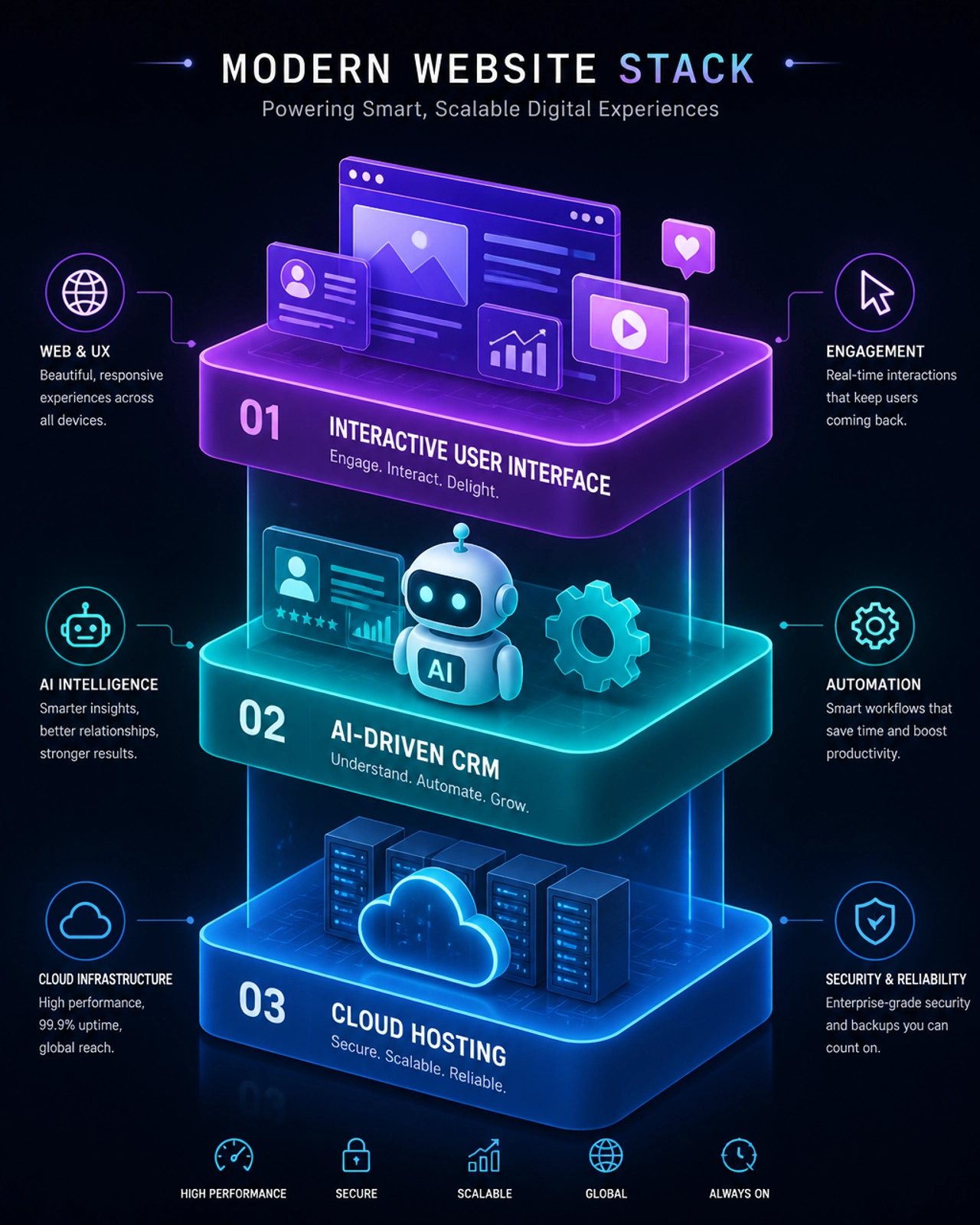
In 2026, a website that just sends an email notification to your inbox is officially obsolete. Your website needs a "Brain": a CRM (Customer Relationship Management) system that is tightly integrated via AI Automation.
Your stack isn't complete without a tool like HubSpot or GoHighLevel. When a lead fills out a form on your site, the stack should automatically:
- Score the Lead: AI analyzes the input to see if they are a high-value target.
- Route the Lead: Send the data to the right person on your team.
- Initiate the "Instant Callback": While they are still on your site, the system should trigger a text or an automated follow-up.
This isn't "future tech": this is what your competitors in Philly are already doing. If you're still manually typing email addresses into a spreadsheet, you're losing the race before it even starts.
3. The Hands: Automated Intake & Chat
If the CRM is the brain, automation is the "hands" that do the work while you sleep. We’re moving away from generic "Contact Us" forms.
The 2026 stack utilizes AI-Powered Intake Forms. Instead of a static list of questions, these forms adapt in real-time. If a visitor selects "Emergency Repair," the form skips the fluff and goes straight to scheduling and payment.
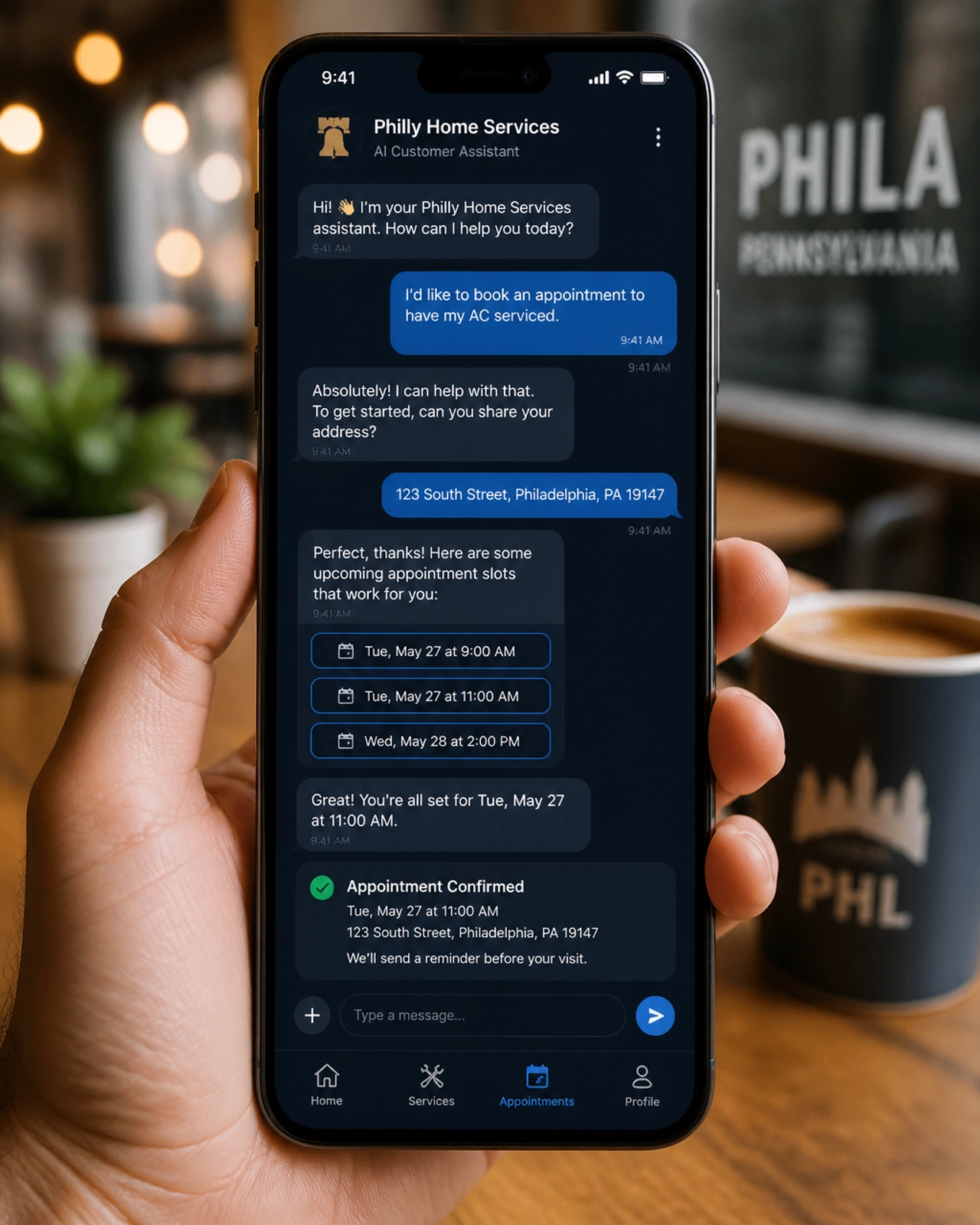
Furthermore, AI Chatbots have evolved. They no longer say, "I don't understand that." In 2026, they are trained on your business data. They can handle pricing questions, check your availability, and even handle basic troubleshooting. This isn't about replacing your team; it's about giving your team the freedom to focus on closing deals rather than answering "What are your hours?" for the tenth time today.
4. The Visibility Layer: Local SEO & Schema
You can have the most beautiful stack in Pennsylvania, but if nobody finds it, it’s a digital paperweight. The 2026 stack includes a heavy emphasis on Schema Markup and Local Signals.
Google (and the various AI search engines that have emerged) now looks for "structured data." Your website needs to "speak" to these engines in their language, telling them exactly where you are located, what services you offer, and showing off your real-time reviews.
We integrate this directly into our Custom Web Design process. It’s not an "add-on" you buy later; it’s baked into the code from day one. This ensures that when someone searches for "best web design Philadelphia," your business shows up with the right stars, the right map pin, and the right authority.
5. What to Avoid: The "Fluff"
Part of building a "No-Fluff" stack is knowing what to throw in the trash. In 2026, you should avoid:
- Excessive Plugins: Every plugin is a potential security hole and a speed killer. If a feature can be handled by a lightweight AI Automation or a simple webhook, do it that way instead.
- Stock Photography Overload: Authenticity is the currency of 2026. Philadelphia customers want to see your office, your team, and your work.
- Manual Data Entry: If you find yourself copying data from your website and pasting it into your accounting software (like QuickBooks), your stack is broken.

Putting It All Together
So, what does the perfect 2026 Philadelphia Small Business stack look like in practice?
- Core: WordPress (optimized for speed).
- Design: Mobile-first, ADA-compliant, and conversion-focused.
- CRM: HubSpot or GoHighLevel (connected via API).
- Automation: Zapier or Make.com handling the "handshakes" between tools.
- Analytics: GA4 and Heatmapping to see what people actually do on your site.
Building this might sound daunting, but it’s exactly why we’re here. At BENT Enterprise, we don't just "build websites." We build growth engines. We take the tech off your plate so you can get back to running your business.
Ready to audit your current setup? Let's see where your stack is leaking money. Contact us today for a consultation tailored to the Philadelphia market.