
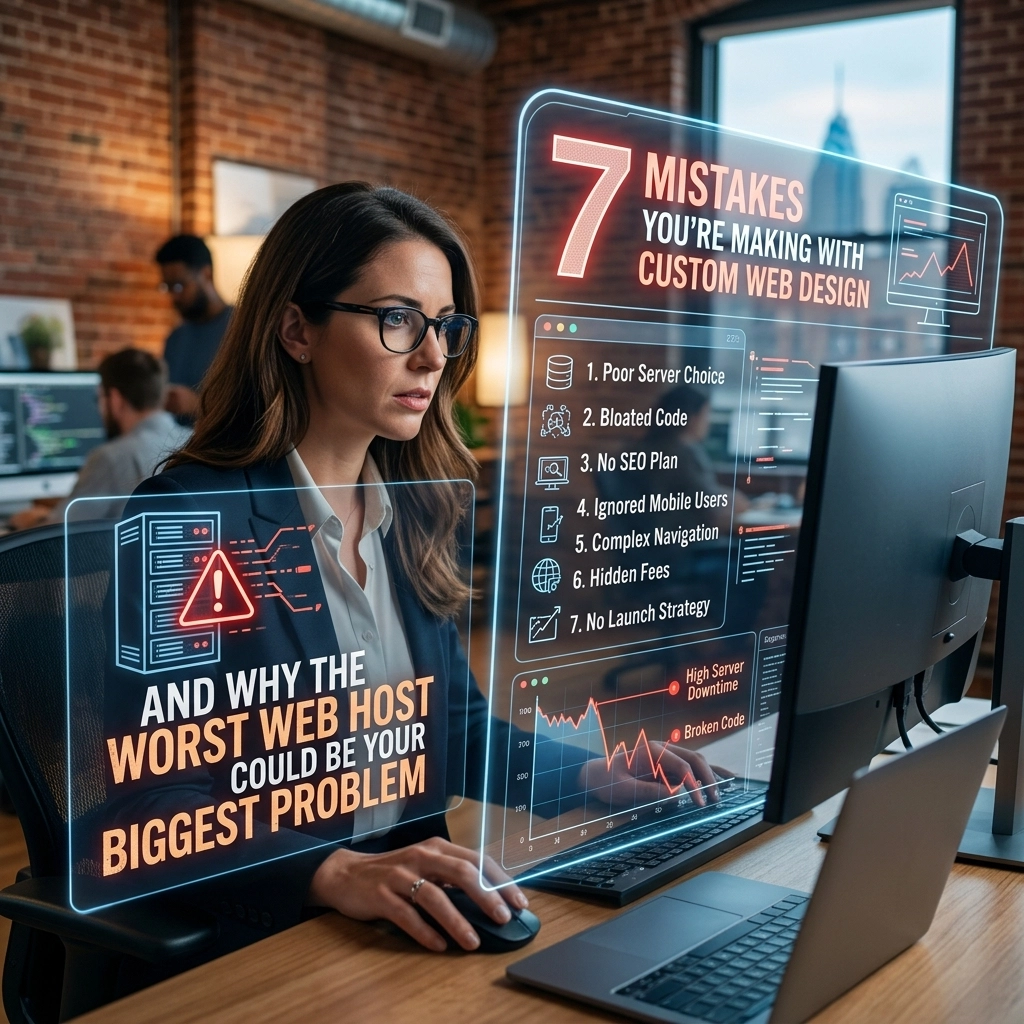
7 Mistakes You’re Making With Custom Web Design (And Why the Worst Web Host Could Be Your Biggest Problem)
If you’re running a business in Philadelphia: whether it’s a boutique in Rittenhouse Square or a contracting firm in Northeast Philly: your website is no longer just a digital business card. By 2026, it has become your hardest-working employee, your 24/7 salesperson, and your primary operations manager.
However, we see it all the time at BENT Enterprise: brilliant business owners investing thousands into Custom Web Design only to fall into the same avoidable traps. A "pretty" website doesn't always equal a "profitable" one. In fact, some of the most beautiful sites on the web are absolute nightmares under the hood, costing owners leads, rankings, and sanity.
Let’s dive into the seven biggest mistakes you’re likely making with your custom web design right now: and why that $5-a-month hosting plan might be the anchor dragging your entire brand down.
1. Building a "Static" Brochure in an AI World
The biggest mistake in 2026 is treating your website like a printed flyer. Back in the day, you’d put up your services, a bio, and a phone number, and call it a day. Today, if your website isn't interacting with your visitors, you're losing them.
Custom web design now requires AI Integrations. If a potential client visits your site at 2:00 AM, they shouldn't have to wait until 9:00 AM for a response. Integration of smart AI assistants can handle FAQs, qualify leads, and even schedule consultations directly into your calendar. When you ignore these AI operations for your Philadelphia business, you aren't just being "old school": you're being invisible to the modern consumer.
2. Friction-Heavy Lead Intake
We’ve all seen them: the dreaded "Contact Us" forms with fifteen different fields asking for everything including your childhood pet's name. This is a conversion killer.
Custom design should prioritize the user's ease of use. In 2026, we utilize AI-powered intake forms that use conditional logic to only ask the necessary questions. Instead of a clunky box, your website should feel like a conversation. If your form doesn't automatically sync with your CRM or trigger an automated follow-up, you're creating manual work for yourself that leads to "human error" and lost revenue.

3. Designing for Desktop First (Still!)
It sounds crazy to say this in 2026, but many "custom" builds are still designed on big 27-inch monitors, with mobile responsiveness treated as an afterthought.
For Philly small businesses, your customers are finding you while they’re walking down Broad Street or sitting in traffic on the Schuylkill. If your site takes more than two seconds to load on a 5G connection or if the buttons are too small for a thumb to click, they will bounce back to the Google search results faster than you can say "Go Birds." Mobile-first design isn't a feature; it’s the foundation of successful local SEO services in Philadelphia.
4. The "Stock Photo" Identity Crisis
Your business is unique. Your team is local. So why does your website feature the same generic "smiling business people shaking hands" that every other company in the country uses?
Custom web design should reflect the grit and personality of your specific brand. In 2026, users have "stock photo blindness." They want to see your actual projects, your actual office, and your actual face. Using generic imagery kills trust. If you want to outrank the big national franchises, you need to look like the local expert. Authenticity is a high-converting design element that no AI (ironically) can fully replicate without your direction.
5. Ignoring Local SEO Data in the Design Phase
A common mistake is separating "Design" from "SEO." Many agencies build a beautiful site and then try to "add the SEO" later. That’s like building a house and trying to install the plumbing after the walls are closed.
Structure matters. Your headers, your URL architecture, and your internal linking strategy must be baked into the custom design. For example, if you aren't optimizing your site architecture for Philadelphia-specific search terms from day one, you’ll spend twice as much money later trying to fix it. Design should follow function, and in the digital world, the function is being found.
6. Over-Designing and Under-Delivering
Sometimes, "custom" leads to "complicated." We see sites with heavy animations, auto-playing videos, and complex navigation menus that require a map to find the "Services" page.
In 2026, speed and clarity are the ultimate luxuries. If a user has to guess where to click, they’ll leave. Your design should guide the eye toward a single goal: the Call to Action (CTA). Whether it’s booking a call, downloading a guide, or making a purchase, the path should be frictionless. Avoid the "shiny object syndrome" where you add features just because they look cool. If it doesn't help the user solve their problem, it doesn't belong on the page.
7. The Fatal Flaw: Choosing the Wrong Web Host
This is the "Biggest Problem" promised in the title. You can spend $10,000 on the most advanced, AI-integrated, custom-designed website in Pennsylvania, but if you host it on a bargain-bin shared server, you are sabotaging yourself.
Think of your website like a high-performance sports car. Your web host is the fuel and the road it drives on. If you put cheap, dirty fuel in that car and try to drive it through a muddy field, you’re not going anywhere fast.
Why Your Host Matters More Than You Think:
- Speed is a Ranking Factor: Google’s "Core Web Vitals" are more important than ever in 2026. A slow host means a slow site, which means lower rankings on the Map Pack.
- Uptime = Trust: If a lead clicks your ad and hits a "500 Internal Server Error" page because your cheap host crashed, they won't come back.
- Security Vulnerabilities: Low-end hosts often cut corners on security. For an integrated website that handles customer data and lead info, a breach could be a legal and reputational nightmare.
- Integration Support: Modern websites rely on Webhooks, APIs, and server-side processing for AI tasks. Many "cheap" hosts block these processes to save on resources, breaking your automations.
When choosing your 2026 website stack, treat hosting as a critical infrastructure investment, not a monthly nuisance bill.
How to Fix It: The BENT Enterprise Approach
At BENT Enterprise, we don't just "make websites." We build operational engines. Our process avoids these seven mistakes by merging world-class design with practical automation and rock-solid foundations.
When we take on a custom build, we look at the big picture:
- Discovery: Understanding your Philly business goals.
- Architecture: Setting up an SEO-friendly structure that scales.
- Integration: Connecting AI tools and CRMs so you don't have to copy-paste data manually.
- Performance: Hosting your site on optimized environments designed for speed and security.
Your website shouldn't just look good on a portfolio; it should look good on your profit and loss statement. By avoiding these custom design mistakes and ensuring your hosting foundation is strong, you’re setting your business up for a massive advantage over the competition.
Ready to level up?
Stop letting small design mistakes and bad hosting hold your business back. If you’re ready for a website that actually works as hard as you do, let’s chat. Whether you need a ground-up custom build or you want to integrate AI into your existing workflow, we’re here to help Philadelphia businesses lead the way in 2026.
Contact BENT Enterprise today to see how we can transform your digital presence.