
The 2026 Website Stack: What to Use and Why to Avoid the Worst Web Hosting Services
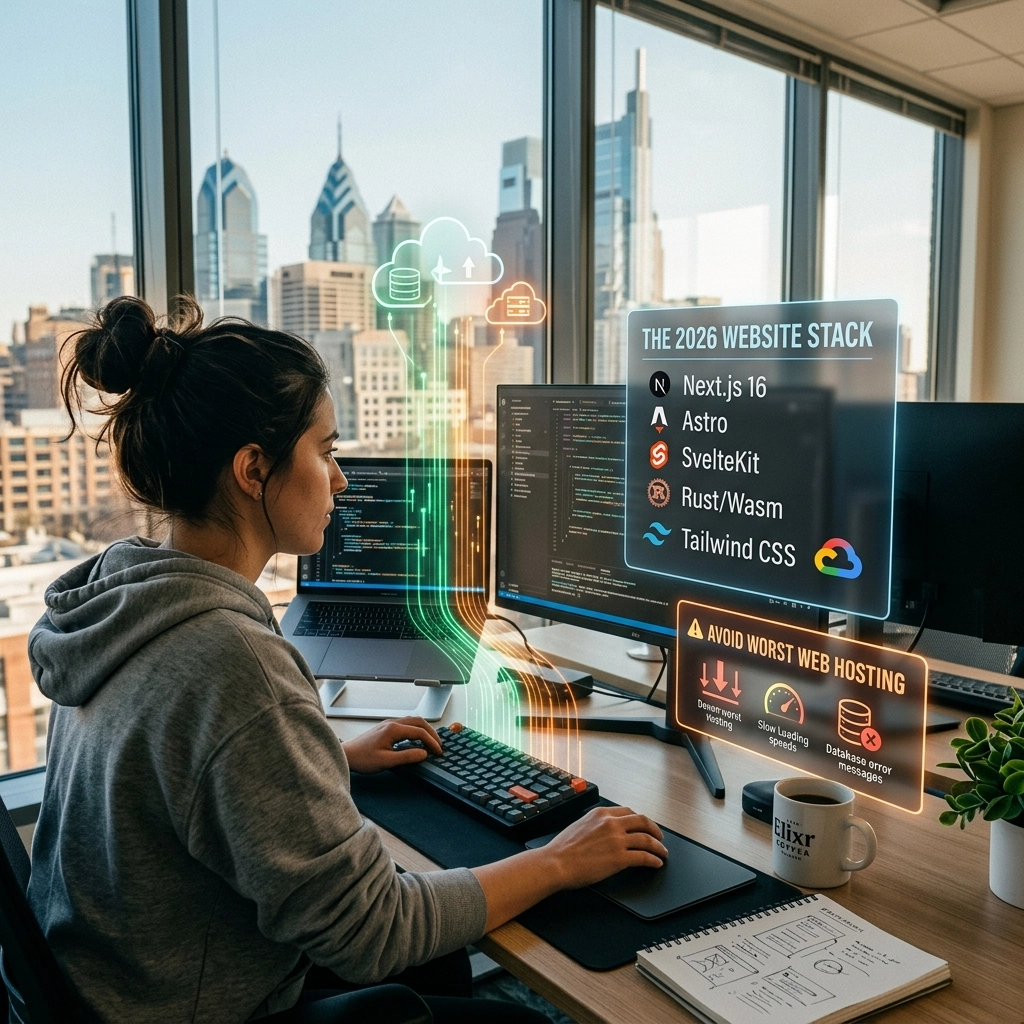
Hey there, Philly business owners! Francis here from BENT Enterprise. It’s May 2026, and if you haven’t looked at your website’s "under-the-hood" tech in the last two years, I have some news: the game has changed.
Back in 2022 or 2023, you could get away with a clunky site as long as you had a decent offering. Today? Your website isn't just a digital brochure; it’s an automated member of your staff. It’s either helping you close deals while you’re grabbed a cheesesteak at Dalessandro’s, or it’s actively driving customers into the arms of your competitors because it’s too slow, too "dumb," or hosted on a platform that belongs in a museum.
In this guide, I’m breaking down the definitive 2026 Website Stack. We’ll look at the frontend, the backend, and the AI layers that make a modern site hum. We’ll also have a very honest chat about web hosting: specifically, why saving $5 a month on a "bargain" host is actually costing you thousands in lost leads.
The Frontend: Why Speed and SEO are Non-Negotiable
In 2026, the "frontend" (what your customers actually see) needs to be more than just pretty. It needs to be lightning-fast. Google’s algorithms have become obsessed with user experience metrics, and if your site takes more than a blink of an eye to load on a 5G connection in Center City, you’re invisible.
Next.js: The 2026 Heavyweight Champion
At BENT Enterprise, we’ve moved almost entirely toward Next.js for our Custom Web Design projects. Why? Because it offers the best of both worlds: Server-Side Rendering (SSR) and Static Site Generation (SSG).
In plain English: it makes your website feel like an app. Pages load instantly because the heavy lifting is done before the user even clicks. Plus, Next.js is built for SEO out of the box. It ensures that search engines can read every bit of your content without getting stuck in a mess of old-school JavaScript.
Tailwind CSS: Clean, Fast Styling
Gone are the days of massive, bloated CSS files that take forever to download. We use Tailwind CSS to build custom interfaces that are lean. It allows us to build unique designs for Philadelphia brands without the "cookie-cutter" look of 2010-era templates.

The Intelligence Layer: AI Integrations That Do the Work
A 2026 website stack isn’t complete without an AI layer. If your website is just sitting there waiting for someone to fill out a 10-field contact form, you’re living in the past.
Modern stacks integrate AI directly into the user journey. This includes:
- AI-Powered Intake: Forms that adapt based on what the user types, qualifying leads before they even hit your inbox.
- Dynamic Personalization: Showing different content to a returning customer than you do to a first-time visitor.
- Automated Scheduling: Connecting your site directly to your CRM and calendar so you stop playing "email tag."
Integrating these tools requires more than just a plugin; it requires a strategic approach to data. That’s where our Managed AI Integration Support comes in. We ensure your website isn't just "smart" but actually talks to the rest of your business tools like QuickBooks or your CRM.
The Foundation: Why Your Hosting Service Can Be Your Worst Enemy
Let's talk about the "elephant in the server room." I see too many local businesses spend thousands on a beautiful design only to host it on a $3-a-month shared hosting plan from a legacy "big box" provider.
Why to Avoid the "Worst" Hosting Services
You know the ones: the massive companies that offer "unlimited" everything for the price of a cup of coffee. In 2026, these are the "worst" because they use outdated hardware and cram thousands of websites onto a single server.
- The "Neighbor" Problem: If another website on your shared server gets a spike in traffic (or gets hacked), your site slows down or crashes.
- Security Gaps: Cheap hosts are magnets for malware. If your site gets flagged by Google for security issues, your Local SEO Services efforts go down the drain instantly.
- Terrible Support: When your site goes down at 9:00 AM on a Monday, you don’t want to wait 4 hours for a chatbot.
What to Use Instead: Managed Cloud Hosting
In 2026, we recommend Managed Cloud Hosting (think Vercel, Netlify, or specialized Google Cloud/AWS setups). These platforms are "headless-ready," meaning they are built specifically to handle modern frameworks like Next.js. They offer:
- Edge Computing: Your website is stored on servers all over the world, so a visitor in Philly gets the data from a local node, making it insanely fast.
- Auto-Scaling: If you get a shoutout on the local news and your traffic spikes, the server automatically scales to handle it. No crashes.
Technical SEO: The Hidden Stack
Your stack also includes the invisible "pipes" that help Google understand your site. In 2026, this means having a rock-solid Schema Markup strategy and meeting Core Web Vitals with room to spare.
If your backend is messy, your Technical SEO Services will struggle. A modern stack ensures that your site structure is logical, your images are auto-optimized into WebP or AVIF formats, and your code is minified. This isn't just "tech talk": this is how you win the Map Pack in Philadelphia.
The 2026 Checklist: Is Your Stack Up to Date?
If you’re wondering if your current setup is holding you back, ask yourself these three questions:
- Does it load in under 2 seconds on a mobile phone? (If not, your hosting or your frontend framework is likely the culprit).
- Does it talk to my CRM? (If you’re manually re-typing lead info, your integration layer is missing).
- Is it accessible? (In 2026, ADA compliance is a legal and moral necessity). You can learn more about how we handle this on our ADA Web Solutions page.
Final Thoughts: Build for the Future
The 2026 website stack is about integration, speed, and intelligence. It’s about moving away from the "all-in-one" builders that try to do everything (and do it all poorly) and moving toward a modular, high-performance architecture.
Choosing the right stack: and avoiding the trap of bottom-tier hosting: is the difference between a website that is a cost center and a website that is a revenue engine.
Ready to upgrade your business with a stack that actually works? Don't let a slow host or an outdated platform hold your Philly business back. Let’s build something that scales.
Reach out to us at BENT Enterprise today and let’s talk about your 2026 upgrade plan.
Related Reading:
- The Hidden Cost of Disconnected Tools (And How to Fix It)
- AI-Powered Intake Forms: Turning Website Leads into Clean, Usable Data