
How to Choose the Best 2026 Website Stack: What to Use (And How to Spot the Worst Web Hosting Services)
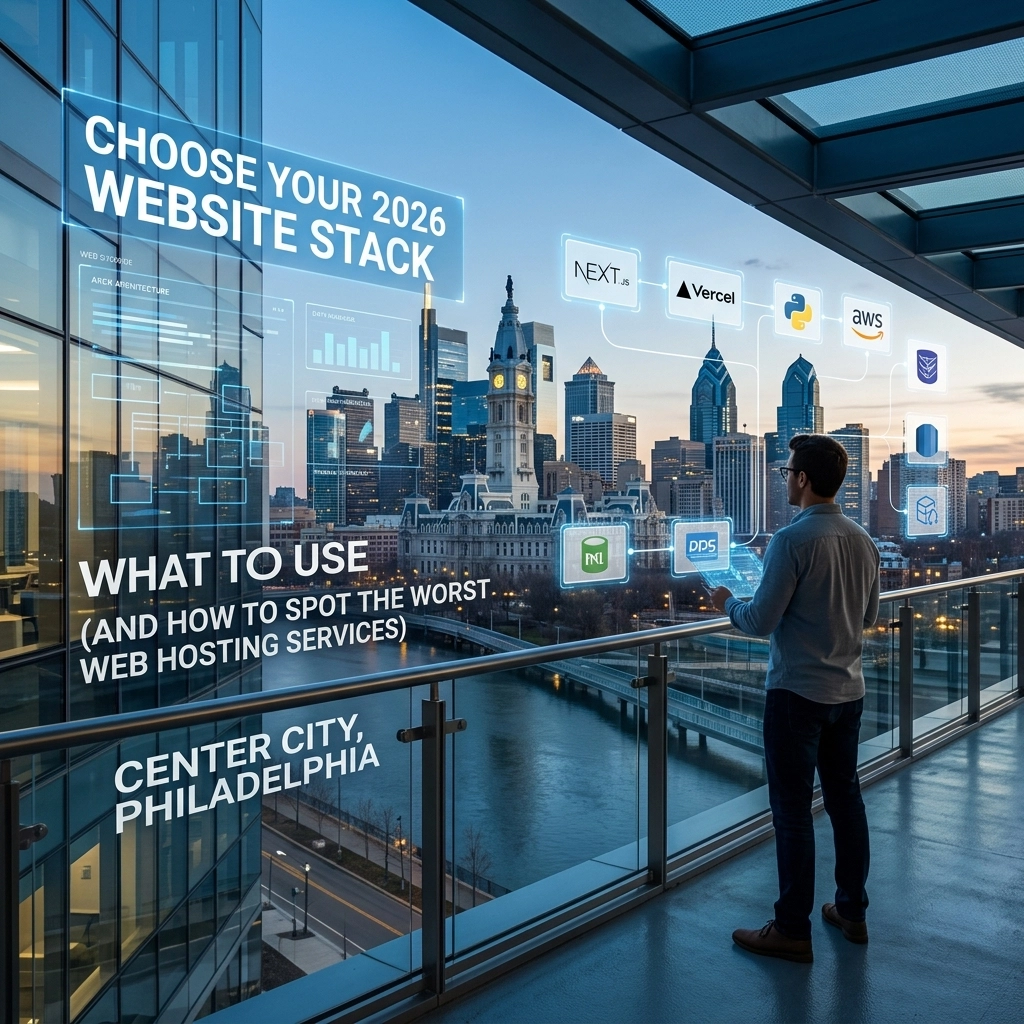
If you’re running a business in Philadelphia: whether you’re a law firm in Center City or a specialized contractor in Fishtown: the digital landscape in 2026 looks a lot different than it did just a few years ago. We’ve moved past the era where a "website" was just a digital brochure. Today, your website is the primary engine for your operations, your lead generation, and your customer service.
Choosing the right "stack": the collection of technologies used to build and run your site: is no longer a decision just for the IT department. It’s a business-critical decision. Get it right, and your business scales with AI-powered efficiency. Get it wrong, and you’re stuck with a slow, disconnected mess that costs more to maintain than it generates in revenue.
At BENT Enterprise, we focus on building websites that don't just look pretty, but actually work. In this guide, we’ll break down what the 2026 website stack looks like and how to avoid the hosting traps that sink so many local businesses.
What Exactly is a "Website Stack" in 2026?
Think of your website stack like the foundation, framing, plumbing, and electrical of a building. In 2026, the "plumbing" isn't just about showing images; it’s about how your data flows between your website, your CRM, and your AI tools.
The modern stack generally consists of:
- The Frontend: What people see (React, Next.js, or Astro).
- The Backend: The logic behind the scenes (Node.js, Python, or specialized API layers).
- The Database: Where your customer info lives (PostgreSQL or Pinecone for AI data).
- Integrations: The "connectors" that link your site to your calendar, payment processors, and AI assistants.

The Winning Stacks for 2026
Depending on your business goals, some technologies make more sense than others. Here’s what we’re seeing work best for Philadelphia small businesses this year.
1. The "AI-Native" Stack (For High-Growth Service Businesses)
If you want your website to handle customer inquiries, qualify leads automatically, and sync with your internal tools, you need an AI-native approach.
- Technologies: Python FastAPI, React, and LangChain.
- Why it works: Python is the language of AI. Using FastAPI allows your website to communicate lightning-fast with LLMs (Large Language Models). This allows you to build custom AI Services directly into your site, like a 24/7 assistant that actually knows your pricing and schedule.
2. The "Performance First" Stack (For Local SEO Dominance)
If you rely heavily on Google to find you (like HVAC, plumbing, or legal services), speed and SEO are everything.
- Technologies: Astro or Next.js.
- Why it works: These frameworks use a technique called "static site generation" or "server-side rendering." Basically, they deliver the website to the user’s phone instantly. In a city like Philly, where people are searching on the go with spotty 5G, speed is a ranking factor you can’t ignore. This is a core part of our Custom Web Design philosophy.
3. The "Reliable Scaler" (For Established SaaS and Portals)
If you’re building a platform where users log in, manage data, or process complex transactions, you need stability.
- Technologies: The T3 Stack (Next.js, TypeScript, Tailwind, Prisma).
- Why it works: It’s robust, secure, and incredibly easy to scale. It prevents the "spaghetti code" that makes older websites so hard to update.
Why Your Stack Needs to be "Integration-Ready"
The biggest mistake we see Philadelphia businesses make is choosing a "closed" stack: like some of the older drag-and-drop builders. While they look easy at first, they often won't talk to your other software.
In 2026, your website should be the hub of your business. If a lead fills out a form on your site, that data should automatically:
- Move into your CRM.
- Ping your AI to draft a personalized follow-up.
- Check your Google Calendar for availability.
To do this, you need a stack that excels at API Integrations. Without this, you’re just creating more manual work for yourself.
Web Hosting: The Foundation (Don't Get Burned)
While the stack is the "what," hosting is the "where." In 2026, hosting has become a commodity, but there are still plenty of "worst-in-class" services that can ruin a perfectly good website build.
You don't need to spend a fortune on hosting, but you do need to avoid the bottom-of-the-barrel providers. Here is how to spot a web hosting service you should avoid:
1. The "Unlimited" Trap
If a host promises "unlimited everything" for $3.99 a month, run. In reality, they are cramming thousands of websites onto a single server. In Philly's competitive market, a 3-second delay in load time because your neighbor’s site is hogging resources is enough to lose a lead to a competitor.
2. Lack of Native AI Support
Modern websites often need "edge computing": the ability to run small bits of code closer to the user. If your host doesn't support modern deployment platforms (like Vercel, Netlify, or specialized AWS/Google Cloud setups), your Managed AI Integration Support will be sluggish and buggy.
3. "Proprietary" Hosting Locks
Some agencies will build your site on a platform that only they can host. This is a massive red flag. If you decide to leave that agency, you lose your entire website. We always recommend building on open-source or widely supported stacks so you own your digital assets.
The Philly Business Advantage: Localized Tech
Why does a "Philly-centric" approach matter for your tech stack? Because your customers are local.
When we implement Local SEO Services, we ensure your stack includes things like Schema markup and lightning-fast local delivery. If your server is in Singapore but your customers are in Manayunk, you’re adding unnecessary millisecond delays that hurt your Google ranking.
We also focus on Google Business Page Optimization, making sure your website stack and your Google profile are perfectly synced to show "Open Now" or "Live Chat Available" in the local map pack.
How to Choose? A Quick Checklist
Before you sign a contract for a new build in 2026, ask your developer these questions:
- Is this stack "headless" or "decoupled"? (This allows for better speed and future-proofing).
- How does this site handle AI data? (Even if you don't use AI today, you will tomorrow).
- Can we easily connect this to my CRM via Webhooks or APIs?
- What is the mobile performance score? (Check out our guide on what visitors expect in 2026).
Putting It All Together
Your website stack is the heartbeat of your digital presence. In 2026, the "best" stack isn't just the one with the coolest buzzwords; it's the one that eliminates friction for your customers and manual labor for your team.
Whether you need a full Web Development overhaul or you’re just looking to plug some AI power into your existing setup, the goal should be the same: a fast, integrated, and scalable system that works while you sleep.
Ready to Upgrade Your Stack?
Don't let your business get left behind with 2020 technology. At BENT Enterprise, we help Philadelphia businesses bridge the gap between "standard websites" and "AI-powered operations engines."
If you're tired of disconnected tools and slow hosting, let’s talk. We can audit your current setup and show you exactly where your "stack" is leaking money.
Contact BENT Enterprise Today to start building a smarter, faster, and more profitable website for 2026 and beyond.