
Why CRM + Website Personalization Will Change the Way You Use Local SEO Services in 2026
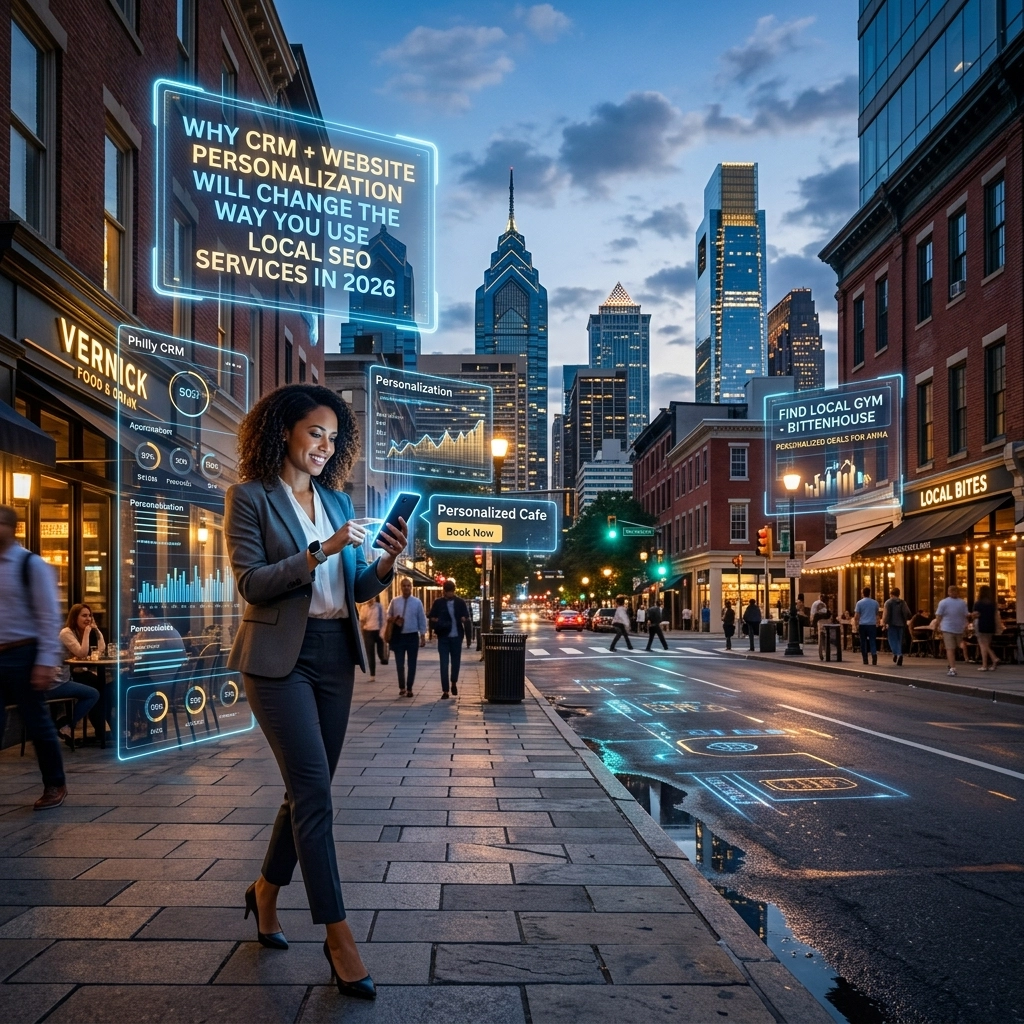
If you’re running a business in Philadelphia in 2026, you already know that the digital landscape has shifted. Gone are the days when simply having a "mobile-friendly" site and a few keywords was enough to land you in the Google Map Pack. Today, the game is about trust, relevance, and: most importantly: how well you actually know the person clicking on your link.
At BENT Enterprise, we’re seeing a massive trend that is redefining how local businesses approach growth: the marriage of CRM (Customer Relationship Management) data and real-time website personalization.
It sounds high-tech (and it is), but the concept is simple. Instead of showing every visitor the same generic homepage, your website becomes a living, breathing sales assistant that remembers who people are and what they need. When you combine this with your local SEO services, you don't just get more traffic: you get the right traffic, and you keep it.
The Death of the Generic Landing Page
In 2026, the "one-size-fits-all" website is officially a liability. Think about it: if a customer in South Philly has already hired you for a roof repair three times, why are they seeing a "New Customer Discount" pop-up when they visit your site? Conversely, if a brand-new prospect from the Main Line is looking for high-end kitchen remodeling, why are they seeing photos of commercial warehouse repairs?
Generic content leads to high bounce rates. High bounce rates tell Google that your site isn't relevant. And when Google thinks you aren't relevant, your rankings in the local search results start to tank.
By integrating your CRM with your custom web design, you can flip the script. You can serve up dynamic content blocks based on the user's history, location, and even their stage in the buying journey.

Why Google Loves Personalization (and Why Your Rankings Will Too)
You might be wondering, "Penny, what does my CRM have to do with SEO?"
The answer lies in how Google’s Search Generative Experience (SGE) and local algorithms have evolved. By 2026, Google isn't just looking at your backlinks; it’s looking at user signals. They are measuring how long people stay on your page, whether they find what they are looking for, and if they take action.
When a website is personalized:
- Dwell time increases: People stay longer because the content is actually relevant to them.
- Conversion rates spike: Personalized calls-to-action (CTAs) convert significantly better than generic ones.
- Positive sentiment grows: Users who have a great experience are more likely to leave positive reviews, which is a massive ranking factor for local SEO services.
Google sees this engagement and identifies your site as a high-authority, high-trust resource for the Philadelphia area. Essentially, your CRM data becomes a secret weapon that boosts your organic visibility.
The Philly Business Advantage: Hyper-Local Personalization
Let's look at a real-world scenario for a service-based business in our city.
Imagine you run a plumbing company. A visitor arrives at your site. Through a mix of AI-driven data and CRM integration, your website knows two things: they are located in Fishtown, and they previously looked at "tankless water heater" blog posts.
Instead of a hero image showing a generic leaky faucet, your website dynamically updates to show:
- Headline: "The Top-Rated Tankless Water Heater Experts in Fishtown."
- Social Proof: "We’ve helped 45 of your neighbors in the 19125 area save on energy bills."
- The Offer: "Schedule a free consultation for your Fishtown home today."
This level of detail is only possible when your website and your CRM are talking to each other in real-time. This is why at BENT Enterprise, we focus so heavily on Managed AI Integration Support. We don't just build a site; we build an ecosystem that knows your customers as well as you do.
AI: The Engine Behind the Personalization
Scaling this level of personalization manually would be impossible for a small business owner. You don’t have time to write 500 different headlines. This is where AI automation steps in.
In 2026, we use AI to analyze the data coming out of your CRM: things like purchase history, lead score, and previous email interactions: and automatically adjust the website's layout. AI can even help rewrite product descriptions or service benefits on the fly to match the "persona" of the visitor.
For example, if your CRM tags a lead as "Price Sensitive," the AI might prioritize showing your financing options or current promotions. If the lead is tagged as "High-Value/Premium," the site might emphasize your 24/7 concierge service and premium materials.
This isn't science fiction; it’s the standard for businesses that want to dominate the local market. By using Managed AI Integration Support, you can automate these "if/then" scenarios so your website works for you while you’re out in the field.
Bridging the Gap: How to Get Started
If your tools are currently "disconnected": meaning your website lives in one place and your customer list lives in another (or, heaven forbid, on a spreadsheet): you’re leaving money on the table.
The first step is moving away from basic templates and moving toward a strategic custom web design. Your website needs to be built on a foundation that allows for data flow. While hosting and basic maintenance are the "foundation" of your house, the CRM integration is the smart-home system that makes everything run efficiently.
A 3-Step Plan for 2026:
- Audit Your Data: What do you actually know about your customers? If your CRM isn't collecting location data or interest tags, start there.
- Connect the Pipes: Use webhooks or native integrations to ensure that when someone fills out a form on your site, their data is instantly available to your personalization engine.
- Test Local Segments: Start small. Create a personalized experience just for one specific neighborhood in Philadelphia or one specific service line. Measure the difference in conversion rates.
Why This Matters Now
The gap between the "digital leaders" and the "digital laggards" in the local service industry is widening. In 2026, customers expect a frictionless experience. They want to be recognized, not sold to.
By leveraging CRM data to personalize your website, you are providing a level of service that your competitors (who are likely still stuck in 2022) simply cannot match. You’ll find that your local SEO services become much more effective because you aren't just driving traffic to a dead end: you're driving it to a personalized destination.
Ready to Personalize Your Growth?
At BENT Enterprise, we specialize in making these complex integrations feel easy for Philadelphia business owners. We believe your website should be your hardest-working employee, and with the right AI and CRM setup, it can be.
If you’re ready to move past generic SEO and start building a website that actually talks to your customers, we’d love to help. Let’s look at your current stack and see where we can bridge the gaps to drive more revenue.
Contact us today to start building your 2026 growth strategy.
Next up in our 2026 series: "Building a Scalable Website Architecture for SEO and Growth": stay tuned to learn how to structure your site to handle all this new traffic!